Why Smart Glasses Need Different Care Than Regular Glasses
Reviewed
Direct Answer
Smart glasses combine eyewear surfaces with device components, so the relevant care instructions can depend on the model and on whether you are cleaning a lens, frame, or charging area. Manufacturer documents show different methods and moisture limits; they do not support one rule for every device.
Conceptual overview
A map of care zones
These broad areas help frame a care question. The diagram is conceptual; hardware layout and manufacturer guidance vary by model.
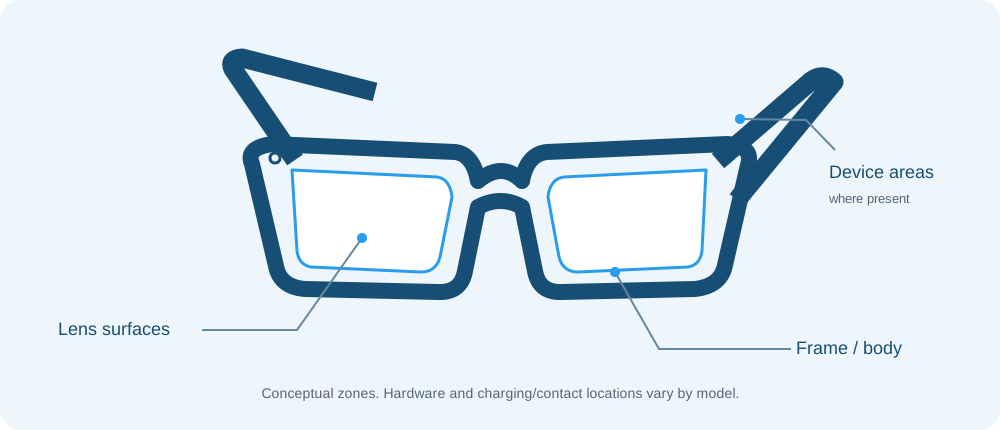
- Lens surfacesCheck the directions for the optical surface.
- Frame / bodyLens directions do not establish frame-care directions.
- Device areas, where presentCharging/contact layout and care vary by model.
The care question depends on the surface
Smart glasses have lenses and frames, alongside electronic and charging components. The manufacturer’s directions may treat these areas differently. That makes model-specific instructions useful; it does not mean every smart-glasses model has the same components, failure modes, or care requirements.
For ordinary glasses, follow their own manufacturer’s instructions too. This comparison is narrow: smart glasses add device-specific care documents and charging considerations, while no claim is made here that regular glasses have no care needs.
Manufacturer examples show why model identity matters
- Ray-Ban Meta Collection Smart Glasses: current Ray-Ban guidance describes a dampened cloth with mild soap, warns against solvents and alcohol, and says not to rinse under running water. Its safety document specifies an included microfiber cloth for the charging port and says not to clean while charging. Refer to the Ray-Ban FAQ and Safety & Warranty document for the current applicable instructions.
- Oakley Meta HSTN and Vanguard: Oakley publishes separate safety documents. The HSTN guide describes dampened-cloth and mild-soap care, avoiding solvents and alcohol, and drying / charging-area precautions. The Vanguard guide has its own exposure limits and specifies 24 hours of air drying before use after liquid exposure. Keep this timing and the Vanguard IP67 rating specific to Vanguard; do not infer an HSTN rating from it. See the Oakley FAQ, HSTN safety guide, and Vanguard safety guide.
- Amazon Echo Frames: the third-generation safety information describes soft dry-cloth care for frames, alcohol-free lens cleaner and a soft cloth for lenses, and drying guidance after moisture exposure. A separate article covers named second- and third-generation glasses and says not to spray cleaner directly on mounted lenses. See the Echo Frames safety information and cleaning article; do not silently extend the advice to other models.
- Even G1: Even permits lens cleaning wipes, suggests moistened microfiber for greasy contamination, and rules out running-water washing, immersion, and ultrasonic cleaning. This is a G1 instruction, not proof that every wipe is suitable for every pair of glasses. See Even’s cleaning and storage guidance.
A rating is not a cleaning method
Some manufacturer documents discuss water resistance, but those statements answer a different question from which cleaning method to use. Ray-Ban’s FAQ gives its own exposure limits. Echo Frames’ third-generation document says IPX4 tested but not waterproof. Vanguard’s IP67 rating and drying directions belong to that model alone. These examples do not establish a category-wide rating or permission to wash smart glasses under running water.
The practical takeaway is simple: identify the exact model, then check its current directions for the surface and situation. Do not carry a liquid, alcohol, wipe, or drying rule from one device to another unless its manufacturer says it applies.
What the evidence does not say
These examples do not show that all smart glasses are fragile, need more frequent cleaning, or are harmed by a particular contaminant. They do not establish effects on coatings, electronics, warranty coverage, repair costs, or device life. Those conclusions would require evidence that addresses the specific model and question.
If you cannot find an instruction for your model or the area you need to clean, use the manufacturer’s support guidance. Avoid guessing based on the appearance of another pair.
Sources
- Ray-Ban Meta FAQsRay-Ban · manufacturerReviewed
- Ray-Ban | Meta Safety & WarrantyRay-Ban | Meta · manufacturerReviewed
- Oakley Meta AI Glasses FAQOakley · manufacturerReviewed
- Oakley Meta AI Glasses Safety & Warranty GuideOakley · manufacturerReviewed
- Oakley Meta Vanguard Safety & WarrantyOakley · manufacturerReviewed
- Safety and Compliance Information for Amazon Echo Frames (3rd Generation)Amazon · manufacturerReviewed
- Cleaning Echo Frames (2nd Gen) and Smart Glasses with Alexa (3rd Gen)Amazon · manufacturerReviewed
- Cleaning & storage recommendationEven Realities · manufacturerReviewed